The Museum
& its Collection
The Grotta dei Cervi (Cave of the Deer) of Porto Badisco, near Otranto in Puglia, is one of the most significant Neolithic cave sanctuaries in Europe. Discovered in 1970, it extends for over 1,500 metres and features three main corridors divided into twelve zones, with paintings gathered in 81 groups. The pictograms were made with pigments derived from subfossil guano (brilliant brown), clays and ground bones (yellowish brown), and ochre (red). Most images are abstract — spirals, sinuous lines, complex motifs — while figurative scenes depict deer, hunters with bows, and dogs.
The cave has been closed to the public since 1987. Human presence — breath, warmth, light — would destroy the fragile microclimate preserving the paintings. Only researchers with special authorisation may enter.
3D Documentation
A high-resolution, full-colour 3D model of the cave was developed starting in 2005 by the University of Salento, led by Professor Virginia Valzano, in collaboration with the Visual Information Technology Group of the IIT-NRC (Canada) and CASPUR (Rome). The model was produced using photogrammetry — overlapping photographs taken from multiple angles, processed computationally to reconstruct geometry without physically touching the walls — combined with 3D scanning. The acquisition took place under extreme conditions — high humidity, difficult access — and required specialised equipment. The resulting model is a milestone: unmatched resolution, never previously achieved for a cave site of this scale. As of September 2025, a permanent exhibition at the Castello Aragonese di Otranto includes a 3D digital twin of Corridor 2, the corridor containing the most significant pictograms. This is the asset the VR experience would be built on: the game engine imports and renders it in real time for the headsets.
Institutional Goals
Let more people know about this cultural heritage treasure — largely unknown due to its inaccessibility — and increase its national and international visibility.
Allow visitors to experience the cave without entering it, preserving the humid environment that keeps the pictograms intact and well-preserved.
Create a virtual environment with no barriers — accessible to everyone regardless of age, language, cultural background or physical limitation.
Concentration · Curiosity · Embodiment · Storytelling. Education happens through immersion, not instruction. Culture triggers emotion; emotion drives action.
Star Assets
The Shaman pictogram — the most iconographically charged image in the cave — as well as the full pictogram ensemble, the mystery of ritual practice, and the 3D model by Professor Valzano are the core star assets. The ability to virtually access a location inaccessible to almost every living person is itself the most powerful asset of all.
Physical Structure
The cave extends for over 1,500 metres of galleries across three main tortuous corridors, with five entrance cavities leading to four painted corridors, reaching depths of up to 28 metres below sea level. Internal conditions — constant temperature, high humidity (the faugnu microclimate), near-total darkness — have preserved the paintings across six millennia, but make the space acutely sensitive to human presence. CO₂ from a single visitor's breath alters humidity levels irreversibly, which is why the 1987 closure remains permanent.
The Twelve Zones
The painted corridors are organised into twelve named zones, each with distinct iconographic content. The second corridor — the richest and most accessible — contains the experience's primary narrative and ritual spaces:
First room of the second corridor. 4 m high. Ochre paintings on wavy, milk-coloured wall surfaces. Contains the foundational mythological narrative: two women and a hunter indicating the way. Notable figure: the Fish Woman, with fins instead of feet.
A large natural anthropomorphic figure (2 m tall), surrounded by threadlike beings in various poses. Among the most complex figurative compositions in the cave, merging human and natural form.
A circular room suited to ritual gatherings, with a lizard or gecko painted at the entrance. The adjoining Hall of Ceremonies depicts six figures in a posture suggesting marathon runners in motion — evidence of communal ceremonial performance.
Small handprints on the ceiling — likely female and child — interpreted as ritual markers of passage from childhood to adulthood. Location of the Lady of the Serpents: a female figure with a seven-rayed crown and S-shaped body, linked by Marija Gimbutas to a Neolithic Mother Serpent Goddess.
A small circular room with a significantly lowered ceiling. Seven pictorial groups with scattered graphemes. A cup for collecting liquids likely served as an altar for ritual ablutions. The tunnel beyond was sealed by a structural collapse.
Hall of Arabesques, Hall of Spirals, and the Recondite Hall. Labyrinthine paintings, stalactites, and the final pictorial groups before the vault lowers and the cave becomes physically impassable.
The Pictograms
Approximately 3,000 pictograms cover the walls across all corridors, painted in red ochre mixed with black bat guano, and dated primarily between 6000 and 3000 BC. Figures are typically rendered in motion. The most frequent subject is the deer — giving the cave its name — followed by hunting scenes, anthropomorphic collectives, agricultural scenes, and dancers. Abstract geometric motifs — spirals, S-shapes, cymbal forms, rhombi, opposed spirals, chevrons, and dots — are distributed throughout, and correspond closely to forms found in caves from Sardinia and Kosovo to France and Romania. The shamans who painted the spirals are thought to have done so under hallucinogens, blows to the head, or pressure on the eye bulbs — all documented methods of inducing the phosphenic geometries that gave rise to the cave's abstract imagery.
Archaeological Findings
Anthropomorphic rim vessels with human faces and notched chin bands; anthropomorphic flask vessels (Scaloria Alta style) with faces on the neck and genitalia on the body; Serra d'Alto style vessels decorated with spirals and S-motifs; graffito vessels bearing a figure closely resembling the Shaman wall painting.
Pintaderas (terracotta stamps used for body decoration during fertility rites), confirming an active Mother Goddess cult and direct Balkan connections. Rhyta for ritual libation. Ceramic ladles for ceremonial serving. Hard animal matter objects of specialised ritual craft.
Cultural Connections & UNESCO
The cave's symbolic vocabulary — spirals, S-motifs, anthropomorphic vessels, cymbal-shaped forms — is shared with sites across southern Italy, Sardinia, Dalmatia, Kosovo, Romania, Bulgaria, and France (including Chauvet Cave, where children's handprints of the same kind appear). This trans-Adriatic and Mediterranean exchange network suggests not merely trade, but a common mythological and religious system across the Neolithic world. The cave was candidated for UNESCO World Heritage Status in 2006 and is part of the 2024 initiative for Karst Caves of Prehistoric Puglia.
"Along the route, there is a narrative unfolding — a history shared and known to those who frequented the cave. The cave must have been the equivalent of what we consider a sanctuary or a place of worship. It certainly houses the richest collection of symbols dating back to the Neolithic — a true ideological manifesto of prehistory — in the entire Western world."
— Elettra Ingravallo, Professor of Palaeontology, University of Salento
The Visitors
The audience is intentionally as wide as the human community that once inhabited the cave, and as diverse as the one that shared a universal visual language across prehistoric sites worldwide. Our primary audience groups are tourists visiting Otranto and Puglia, cultural heritage enthusiasts, and locals with a connection to the territory.
The mystery and inaccessibility of the cave. The fact that digital means are the only way to explore it. The richness of Neolithic pictograms representing the beliefs of a community six thousand years ago.
Physical inaccessibility of the cave. VR side effects (motion sickness, eye strain). Age restrictions: headsets from age 13. Educational gap: not everyone knows Italian Neolithics.
Basic familiarity with digital devices. Mixed reality and casual gaming literacy assumed. Staff onboarding removes barriers for first-time VR users.
4 VR headsets + controllers. Interactive LED display for handprints. Chairs for seated usability. Physical infographic panels at the preamble station.
User Personas
Goals
Cultural identity · Curiosity · Time travel · Wonder · Social interaction
Frustrations
Low self-esteem · Educationally disadvantaged · Complicated technology · Physical strain
Goals
Memorable cultural experience · Learn something surprising about ancient rituals · Immersion with no prior knowledge · Be stunned
Frustrations
Mental overload · Experience for experts only · Not understanding what she sees
Goals
Understand prehistoric people · Experience CH immersively · Connect archaeology and human stories · Learn something meaningful
Frustrations
Closed CH sites · Exhibits that show items with no context · Overly-technical info · No immersivity
User Scenario — Annunziata
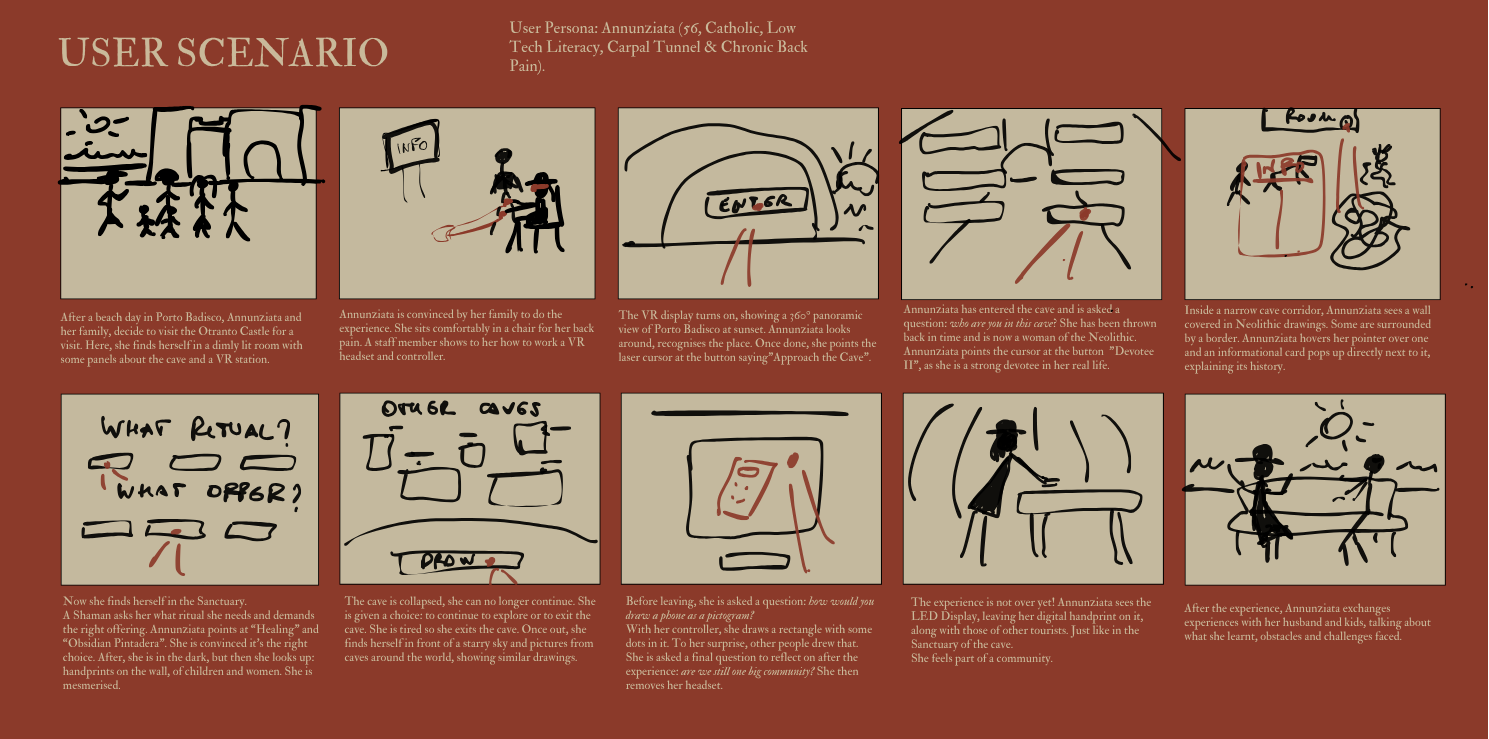
The Core Idea
A multi-character VR experience where visitors physically descend into darkness just as the Neolithic people did thousands of years ago. Each visitor inhabits a role inside the cave and discovers its art through that lens. Education happens through immersion, not instruction. The user journey is the descent into darkness.
The Problems We Are Facing
The Grotta dei Cervi has been inaccessible since 1987, making it impossible to visit directly — even for most researchers. It is largely unknown outside academic and local circles. The experience risks feeling like a passive museum visit rather than something genuinely immersive. VR as a medium presents accessibility barriers: physical discomfort, low digital literacy in older audiences, the need for trained staff.
How We Face Them
By hosting the experience at the Castello Aragonese di Otranto — already a heritage destination — we meet the audience where they already are. A branching narrative with five character roles allows each visitor to engage at their own pace. Groups are encouraged to choose different characters and compare experiences afterward, creating social motivation. The closing handprint activity bridges the ancient and contemporary, making the experience personally relevant regardless of background.
Museological Approach
The project is grounded in interpretive museology, guided by Freeman Tilden's six principles (Interpreting Our Heritage, 1957). Successful interpretation requires a robust mix of media and sensory experiences designed to stimulate curiosity, challenge intellect, and appeal to emotion. Every design decision begins with the visitor — not the collection. The cave's pictograms, zones, and artifacts are always encountered through the lens of a specific role, motivation, and emotional state.
Case Studies & Inspirations
The VR experience at the Rafa Nadal Academy Museum (Manacor, Mallorca) demonstrated how VR transforms passive observation into active participation. The DDR Museum (Berlin) showed how analog objects and interactive displays can be combined to explain history through touch and embodiment. Both were experienced firsthand by team members.
Key Themes
Phosphenic art and altered states of consciousness. The Shaman figure as organiser of symbolic life. The Mother Goddess — recurring female figure linked to fertility, trans-Adriatic cultural exchange. The ritual community — five interdependent roles reconstructing a full Neolithic ceremony. The universality of abstract visual language: the same geometric forms (spirals, concentric circles, zigzags) appear from California to Colombia, suggesting a neurological rather than purely cultural origin.
Community is a central topic of this project: the whole point is to remind people that we live in communities, that we have duties to them and draw strength from them — and that we share the same basic concepts with other communities across time and space.
Needs & MoSCoW
We used the MoSCoW framework to distinguish between what the project absolutely needs, what would improve it, what is possible but non-essential, and what is explicitly out of scope. Requirements were identified by starting from PACT data, then transforming it into information and finally into requirements.
- Historically and archaeologically accurate content throughout
- VR headsets in an atmospherically lit room at the Castello Aragonese
- Five playable character roles
- 3D model developed by Professor Valzano
- Physical preamble station with infographics and accessibility warnings
- Staff presence for onboarding and headset fitting
- Experience usable from a seated position
- VR side-effect and epilepsy warnings before the experience
- Colorblind-safe palette, subtitles, and accessible features
- Interactive LED handprint display at exit
- Multilingual support (minimum Italian and English)
- Closing pictogram drawing activity with global visitor comparison
- Postcard takeaway with QR code linking to the website
- Ambient cave soundscape — dripping water, echoes
- Multiplayer layer for group visitors inside the cave simultaneously
- Adjustable text size for visual impairments
- Additional world cave comparisons beyond those currently mapped
- Kids' version — not a diluted adult version, but purpose-built following Tilden's Interpretative Principles
- Soft background ambient sound (constant but not distracting)
- Physical access to the Grotta dei Cervi
- Direct photography or reproduction of pictograms from the cave
- A fully autonomous experience without any staff presence
- Graphic violence or explicit representation in any version
PACT Analysis
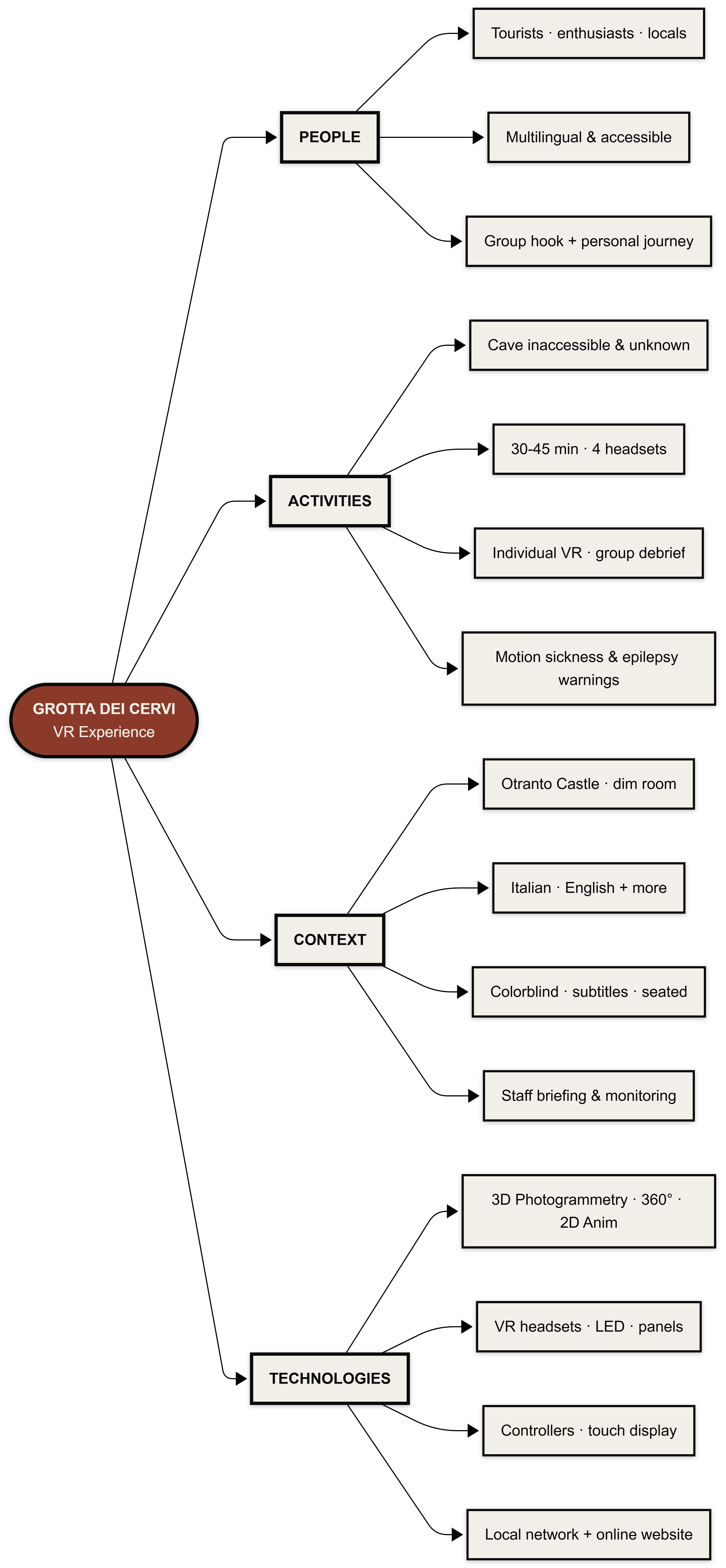
People
International and domestic tourists visiting Otranto and Puglia, cultural heritage enthusiasts, and locals with a connection to the territory. A broad audience — diverse in age, education, cultural background and familiarity with prehistoric art. Groups need a shared social hook; individuals need a personal emotional journey.
Activities
Each full session lasts approximately 30–45 minutes. It runs during museum opening hours in scheduled slots to manage 4 headsets. Peak moments will be tourist season in summer and school visits in spring. The experience is individual inside VR; the character selection mechanic encourages groups to choose different roles for comparison afterward.
Context
A dim, atmospherically lit room inside the Otranto Castle. The historic stone building may have ambient echoing noise. The space accommodates 4 visitors simultaneously with enough room to move safely wearing headsets. Full accessibility is a hard requirement: colorblind-friendly interface, subtitles and visual cues for deaf users, seated usability for mobility-impaired visitors.
Technologies
3D Photogrammetry (cave interior) · 360° panorama at sunset (intro) · Real-time 2D animation (for the fresh painting effect). VR headsets for the main experience. A shared screen displaying the live archive of visitor pictograms. Physical infographic panels at the preamble station. LED display for handprints. The core VR experience runs on a local network; the website is fully online.
The Experience
from the Inside
User Journey
I. The Opening: The Liminal Threshold
The journey begins at the West entrance of the cave during a Salento sunset. A 360° panorama of the Apulian sea — beautiful and brief. Something draws the visitor into the dark mouth of the cave. A single question defines the journey: Who are you?
II. Inside the Cave
The educational content — descriptions of paintings, historical context, significance of symbols — is the same for all characters. What changes is the experience. The Shaman interprets paintings as phosphenic visions. The Devotee II learns about Neolithic artifacts by choosing the correct votive offering for their petition. The Dancer experiences the cave through movement and sound. A 3D model of Professor Valzano serves as academic anchor throughout.
III. The Finale: Intertextuality & The Sanctuary
At the heart of the cave, the narrative expands globally. The visitor sees paintings linked to identical symbols found in caves worldwide — from California to Colombia — reinforcing the project's thesis: this visual language is a universal human trait. A moment of absolute darkness and silence recreates the sensory deprivation that ancient shamans used to trigger phosphenic imagery.
IV. The Physical Outro: The Collective Handprint
The visitor removes the headset and finds a touch-reactive LED screen in the Otranto Castle room. It displays a luminous cloud of handprints left by previous visitors — pale ochre silhouettes on dark background, like the handprints on the ceiling of the Sanctuary. By placing their own hand on the screen, the visitor's print is added instantly. This final gesture bridges the virtual Neolithic past and the physical present.
Storyboard
The storyboard maps the narrative arc for all five character paths across 8 panels: Physical Preamble → VR Opening → Red Hall → Character Paths (5a–5e) → The Sanctuary → The Collapse → VR Exit → Physical Outro.
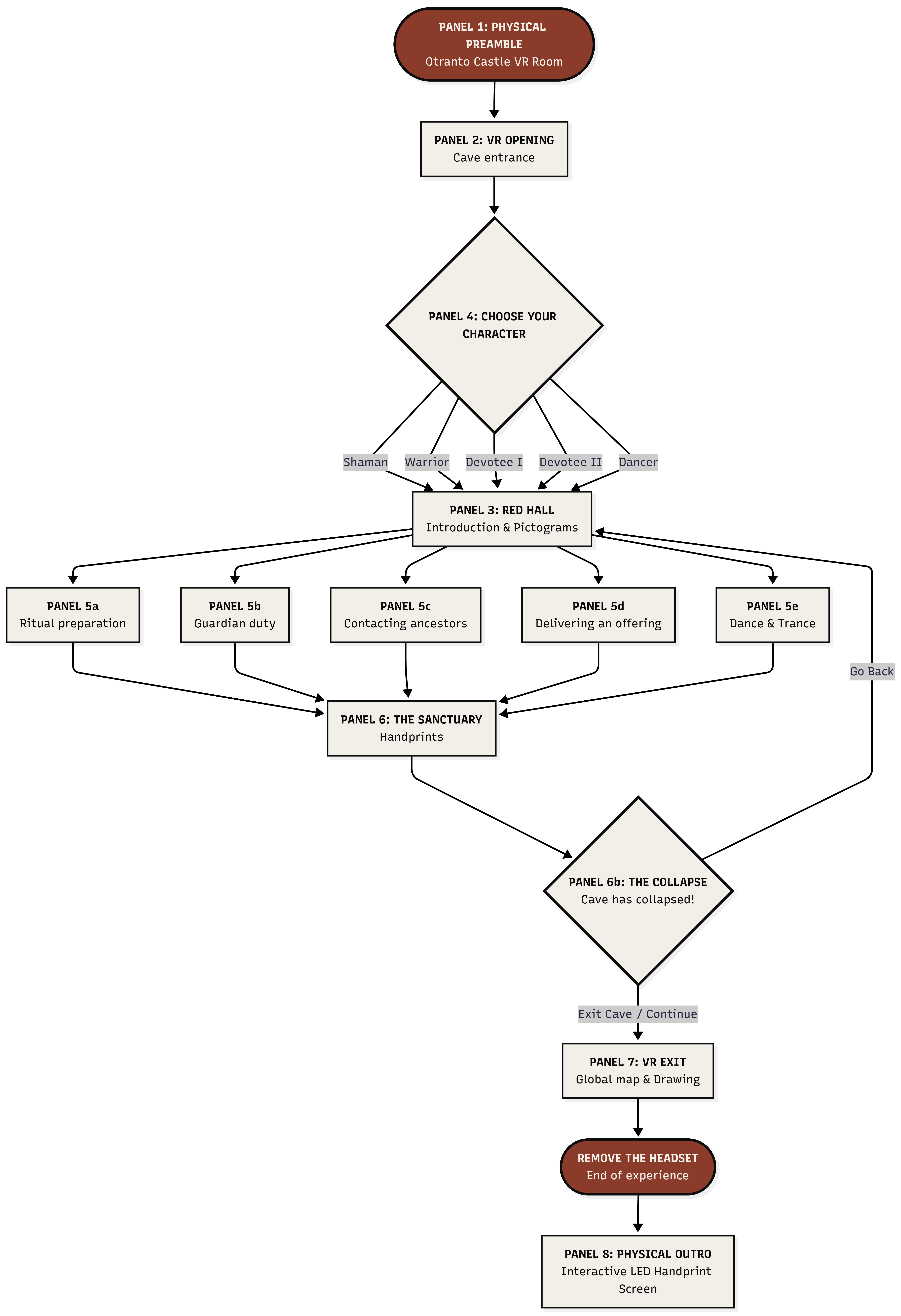
The Five Roles
Emotional Arcs by Character
You perform a ritual for a devotee and, after taking sacred substances, enter a visionary state. The most complete path: every painting becomes a phosphenic vision, every zone a ritual stage. You guide the ceremony — and you are transformed by it.
After fighting off a robber and sustaining an injury, you enter the cave to seek the Shaman's help. The cave is not a place of beauty for you — it is a place of necessity. Power, protection, survival. You leave changed in a way you did not expect.
You seek initiation and communication with your ancestors. The Shaman performs a powerful ritual on your behalf and what you asked for is granted. Transformation through surrender: you enter seeking something and leave as something else.
You carry a votive offering and petition the deity. At the climax of the experience, your ancestor appears and speaks directly to you. The object you chose — ceramic, obsidian, or pintadera — was the key. The cave answered.
You did not choose to come here — you were called. You help the Shaman prepare the ritual; after taking the sacred substances, you begin to dance and fall into vivid visions. The cave moves with you. You do not interpret the paintings. You become them.
The Closing Activity: Draw Your Pictogram
At the end of the VR journey, visitors face a final challenge: "If you were a Neolithic painter, what would you draw?" The system assigns a universal contemporary concept — a phone, a journey, a family, death, love, time — and asks visitors to draw it abstractly with marks, shapes, and lines, using no letters or realistic representation. Just as the Badisco painters did.
The real revelation comes after: the visitor's drawing is placed in a Global Archive alongside every other visitor's drawing of the same concept, gathered over time from visitors worldwide. If the drawings converge — if a spiral still means something spinning, if concentric circles still suggest depth, if a zigzag still means water or danger — then the cave paintings stop being ancient and alien. They become a mirror. The phosphenes were never just Neolithic. They were always ours.
Visual Identity
The project's entire visual language draws from the cave's own artistic vocabulary. The palette is derived from the cave's two pigments: red ochre (iron oxide / haematite, #8B3A2A) and black guano (bat guano / manganese, #1C1A17), on a warm limestone beige ground (#C9B99A). Decorative forms — spirals, concentric circles, labyrinths, grids, dots — serve as both design elements and navigational cues across VR screens, the website, and printed materials.
Foreseen Workflow
Collection and analysis of all academic sources — Leone tracings, Graziosi 1980, Valzano's 3D documentation and publications. Contact with Virginia Valzano for asset permissions and academic consultation. Copyright and usage rights clarification for all third-party materials.
Visit to the Castello Aragonese di Otranto and its permanent Grotta dei Cervi exhibition. Assessment of the VR installation room: dimensions, lighting conditions, electrical infrastructure, accessibility, visitor flow. Visit to Museo Faggiano (Lecce) and MArTA (Taranto) for artifact study.
Definition of the core concept, narrative structure, and character roles. Writing of character scripts and branching logic. Storyboard production. Exhibition flow mapping. Interaction diagram. PACT analysis and persona development. MoSCoW requirements.
Pictogram redraws inspired by published academic tracings. Phosphenic pattern development and visual identity in Adobe Illustrator. UI design across all screens. Website background illustrations. Physical preamble station graphic design. Handprint LED display concept design.
Lo-fidelity wireframes → mid-fidelity layout → hi-fidelity Figma prototype. Twine interactive narrative prototype build and HTML export. Website build and publication on GitHub Pages.
Final website publication with all project documentation, Twine link, Figma link, bibliography, and credits. PPT slides and pitch preparation. Full project review: consistency check across visual identity, narrative content, and museological framework.
User testing of Twine and Figma prototypes with representative target audience users. Accessibility testing: colorblind palette, subtitle readability, seated usability. VR hardware testing in the intended room at the Castello Aragonese. Feedback collection and iteration.
Academic approval from course supervisors. Confirmation of permissions from Virginia Valzano and the Castello Aragonese. Final sign-off on all content, assets, and installation design. Physical setup of four VR headsets, preamble station infographics, and LED handprint display.
Public opening of the exhibition. Submission of Design Brief, Twine scenario, Figma prototype, website, and presentation for academic examination. Post-opening monitoring and maintenance plan handed to venue staff.
Technologies
Hardware
VR Headsets — Meta Quest 2, the most widely deployed headset in museum contexts, supporting seated usability for visitors with mobility constraints. VR Controllers handle primary navigation and role-specific interactions. An Interactive LED Display — large, touch-reactive — is positioned in the physical room as the post-VR handprint screen. A Local Server ensures real-time synchronisation between the headsets and the LED display without internet dependency.
Software
The VR experience is built in Unity or Unreal Engine for real-time 3D rendering and interactive narrative delivery. PTGui is required to stitch the team's Porto Badisco photographs into the final 360° equirectangular panorama used as the VR opening scene.
Media Assets Required
High-resolution HDR panoramas of the Porto Badisco coastline at sunset — the liminal opening scene of the VR experience. Final version to be photographed and stitched in PTGui by the team; current prototype uses a stand-in from 360Cities.
High-fidelity 3D reconstructions of the 12 zones, optimised from Professor Valzano's photogrammetric scans (University of Salento / IIT-NRC Canada / CASPUR Rome). Subject to permissions currently being sought.
Phosphenic-style animations for the pictograms — simulating fresh paint appearing on cave walls, or spiritual visions materialising during the Shaman path. Pictogram redraws based on published academic tracings by Maria Laura Leone.
Ambient cave audio: echoes, dripping water, coastal sounds for the opening scene. No voiceover — immersive VR requires concentrated focus, not narration.
Disruptions
A full VR installation with four headsets, custom narrative content, and professional prototypes requires significant investment. Mitigation: partnerships with the Castello Aragonese, the Municipality of Otranto, regional cultural funds (Puglia Region, MiC), and European heritage programmes (Creative Europe).
The project's archaeological foundation depends on Valzano's 3D reconstructions. Permissions are sought through an ongoing academic relationship.
Motion sickness, disorientation, or anxiety may affect older adults and first-time users. Mitigated by: clear VR warnings at the preamble station, seated-only design, short session duration, trained staff monitoring throughout, and an immediate exit option at any point.
Visitors unfamiliar with VR may feel intimidated. Addressed by staff onboarding, the physical preamble station building familiarity before the headset is introduced, and a controller design limited to single button presses.
Hardware malfunction, software crashes, or connectivity issues could interrupt an experience. Mitigation: daily checks before opening, backup headsets on standby, staff trained for basic troubleshooting.
Despite the seated design, visitors with significant motor impairments may find VR controllers difficult. Future development should include eye-tracking navigation as an alternative input method.
Further Development
Three priority areas identified for future development: a multiplayer layer, allowing a group visiting together to see each other's characters inside the cave simultaneously; adjustable text size for visitors with visual impairments; and a kids' version — not a diluted adaptation of the adult experience, but a purpose-built version following Tilden's Interpretative Principles.
Maintenance
VR headsets require regular hardware upkeep: lens cleaning between sessions, battery charging, strap and hygiene maintenance, and periodic firmware and software updates. A modular content architecture — where individual zones, pictogram descriptions, or educational panels can be updated without rebuilding the entire experience — is essential, as archaeological understanding of the Grotta dei Cervi is ongoing.
Narrative Prototype
An interactive narrative prototype was built in Twine (Harlowe format) to model the branching logic, decision-making dynamics, and the emotional arc of the experience. The prototype implements all five character paths, with looping video backgrounds, CSS animations, and image-based scene backgrounds drawn from archival photographs of the cave's pictograms.
Hi-Fi Prototype
Low-Fidelity Wireframes
Low-fidelity wireframes were developed in Figma across two pages. Page A (External Interface) covers E1 (pre-VR informational panel) and E2 (level selection: Kids / Light / Full). Page B (VR + Physical) maps V1 (sunset entrance + character selection), V2 (Red Hall), V3a–e (five character paths), V4 (Sanctuary), V5 (global phosphenic map), and P1 (physical LED handprint screen).
High-Fidelity Prototype
A complete hi-fi prototype was developed, covering the full user journey from physical arrival to post-experience reflection. The color system is drawn from the cave itself: light beige, black guano, and red ochre. The typeface is IM Fell English, a Google Font whose hand-drawn quality recalls pictographic writing. To simulate a VR feeling inside Figma, panel images can be dragged around. To suggest cave humidity, most panels are set to 60% opacity. No character images are used anywhere in the prototype, by design — users become the character and imagine their own identity freely.
The interface follows Fitt's Law, Gestalt principles, Hick's Law, Miller's Law, and Tidwell's preattentive variables. Figma plugins were used to check accessibility, color contrast, and UI quality. A settings menu allows users to adjust sound, color theme, and font size. Green-dot annotations flag features that could not be fully implemented due to budget or rights constraints.
Team Roles
Ideation · Lo-Fi Prototype · Storyboard · Website
Ideation · Twine · Interpretation · Mid-Fi Prototype
Ideation · Research · Hi-Fi Prototype · Presentation
Bibliography, Sitography
& Tools
Bibliography
Aprile, G., Potenza, A., Tiberi, I., "Grotta dei Cervi, un santuario della Preistoria del Mediterraneo", in XXVIII Valcamonica Symposium 2021: Rock-Art, a Human Heritage, 2021.
Benyon, D., Designing User Experience: A Guide to HCI, UX and Interaction Design, Harlow, Pearson, 2019.
Leone, M. L., La Fosfenica Grotta dei Cervi. Arte Mitologia e Religione dei Pittori di Porto Badisco, 2009.
Valzano, V., "Neolithic Mysteries: Revealing in 3D the Grotta dei Cervi of Porto Badisco", video lecture, CEIT Otranto, 2020, vimeo.com/407669569.
Sitography
Comune di Otranto, La Grotta dei Cervi di Porto Badisco in 3D, comune.otranto.le.it, consultato il 12/05/2026.
Fondo Ambiente Italiano, Grotta dei Cervi, fondoambiente.it, consultato il 12/05/2026.
Focus.it, Ecco la grotta proibita, focus.it, consultato il 12/05/2026.
Preistoria in Italia, Grotta dei Cervi, Porto Badisco (LE), preistoriainitalia.it, consultato il 12/05/2026.
Preistoria in Italia, Messaggi femminili dalla preistoria dell'arte, preistoriainitalia.it, consultato il 12/05/2026.
Puglia Tourism, Grotta dei Cervi, visit.puglia.it, consultato il 12/05/2026.
Tools & Software
Figma (plugins: Unsplash, A11y, Coloors) · Adobe Illustrator · PTGui · Canva · Google Fonts
Twine · HTML · CSS · JS · VS Code · GitHub Pages · Mermaid Live Editor
Notion · CoToolKit · PACT Framework · Microsoft Word · Microsoft PowerPoint · Claude